Definition for carers and identification
The description ‘carer’ is useful to help identify people, including employees, who may be in need of support because of their caring responsibilities.
Who are carers?
Carers UK defines carers as those of us who provide unpaid care by looking after someone who is older, disabled or seriously ill. The description ‘carer’ is useful for identifying people, including employees, who may be in need of support because of their caring responsibilities. However, many people who are ‘carers’ do not see themselves as such and would probably say “I’m just being a husband, wife, dad, son, daughter, friend or good neighbour”.
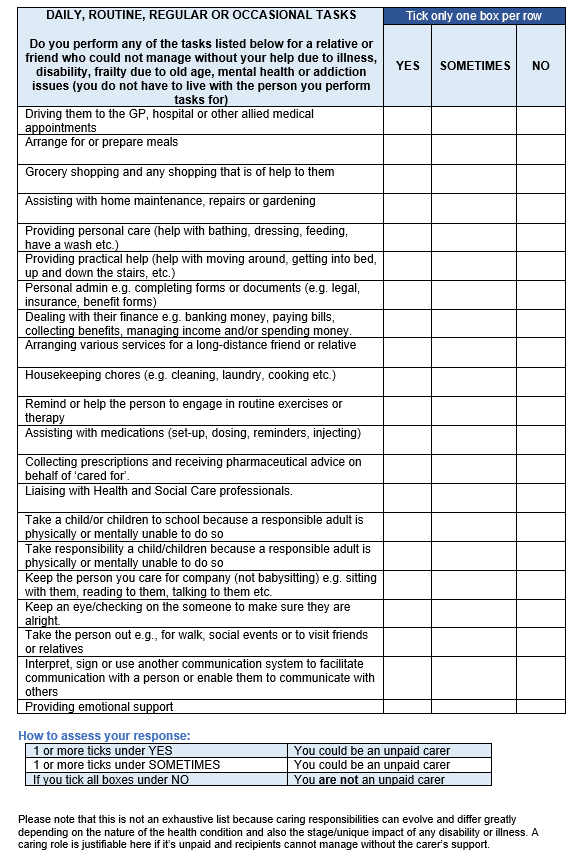
Carers may assist with personal things like getting someone dressed, turning them in their sleep, helping them move about or administering their medication. They may also help with things like shopping, laundry, cleaning, cooking, filling in forms or managing money.
Caring is different from mainstream childcare responsibilities and needs a separate response from employers and managers. Caring can happen overnight or creep up on you unawares, it can be hard to plan and to cope with emotionally and it has different ‘milestones’ to childcare.
For example, the birth of a child is a cause for celebration, but the onset of caring responsibilities for a parent with an illness such as Alzheimer’s Disease is not; a child moving from primary to secondary school education is seen as a positive progression, unlike an adult moving into residential or nursing care.
To find out more about caring, the impact of caring and how to support employees who are caring, you can access our e-learning resources.
Sample definition for carers:
As an organisation you may find it helpful to have your own definition for carers. This is particularly useful if you are looking to develop a carers policy. It can also help when distinguishing between the needs of those with caring responsibilities and those with childcare issues. Employers for Carers have developed the following definition as a best practice example. It is used by many of the group’s member organisations.
EfC Definition:
Carers are employees with caring responsibilities that have an impact on their working lives. These employees are responsible for the care and support of relatives or friends who are older, disabled or seriously ill who are unable to care for themselves.
This definition can be used directly or adapted to suit the needs of your organisation.
Supporting a carer to recognise themselves
Why is it important?
- For the employee, it means that they can access relevant support from the organisation such as flexible working arrangements, carer’s leave and peer support. They will likely improve their wellbeing by seeking support and ultimately be able to sustain their working responsibilities.
- For the employer, it means that you can understand your organisation’s carer population and ensure you are improving and developing support where necessary, measuring effectiveness of that support over time. Through this, you’ll reduce absenteeism, improve retention and create a more inclusive workplace which promotes trust and openness.
Ways that your organisation can encourage identification:
- Creating awareness and normalising carers/caring is an important first step to encourage identification. Use awareness days such as Carers Week and Carers Rights Day to share the word about what being a carer means. Highlight employee case studies, hold webinars or lunch and learn sessions, or include information about carer support practices in regular communications to staff and managers.
- Tell your employees why they should be identifying themselves. What will the data be used for? What are the benefits for them as a carer
- Provide flexible ways for carers to identify themselves. These could include an employee survey where there is a question about caring responsibilities, or having a check box on the internal HR system for employees to declare they are a carer. It could also be through a carers network and monitoring people who join the network. Think about how this works best in your organisation, to fit your organisation’s culture.
- Try to capture carers at each stage of their employment and caring journey.
When employees have caring responsibilities, it can be helpful for them to prove their role to access some types of services and support outside of the workplace. Carers UK has suggestions of different ways that they can provide proof to identify themselves as a carer. Visit the Carers UK webpages to read more.
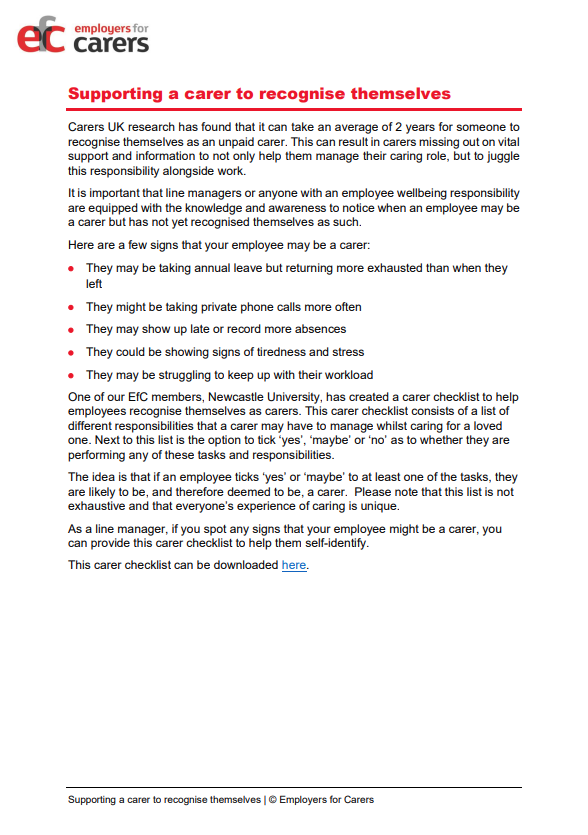
As we know, it can be challenging to encourage carers to come forward and access the support they need. Newcastle University has created a ‘carer checklist’ to help employees to recognise themselves as carers. Along with this, Employers for Carers has provided a resource with information about signs that your employee may be a carer and next steps after an employee has completed the checklist.